The story of how an unexpected mishap became one of my favourite features — our coffered ceilings.
I don’t think I’ve ever truly deep-dived into how our house became our home. Maybe that’s a story for another day… but in short, one afternoon—I was doing my daily market scroll. There was this one neighbourhood I couldn’t stop checking—older homes built with integrity, solid lumber, and lined with mature trees that muffle the city noise and give you that small-town quiet. There’s nothing more nostalgic to me than the 90s and early 2000s. I think of CD players with headphones hanging off kitchen counters, wooden stair railings, honey-oak trim, landline phones with curly cords, a different paint colour in every room, and the faint hum of the dishwasher after dinner. Homes where every room had its own feel and function—you actually used each one for its intended purpose, and that’s what I always find myself searching for: spaces that feel grounding, safe, and whole.
Then one day, a listing popped up. No photos. Not a single one. Just specs and a price. Within the hour, I’d texted our realtor and we were on our way.
We had no idea what we were walking into, like showing up to a blind date with nothing but an address and a feeling. But the moment I saw that little white picket fence, my intuition started whispering. We walked in, I turned the corner, and I gasped: a sunken living room.
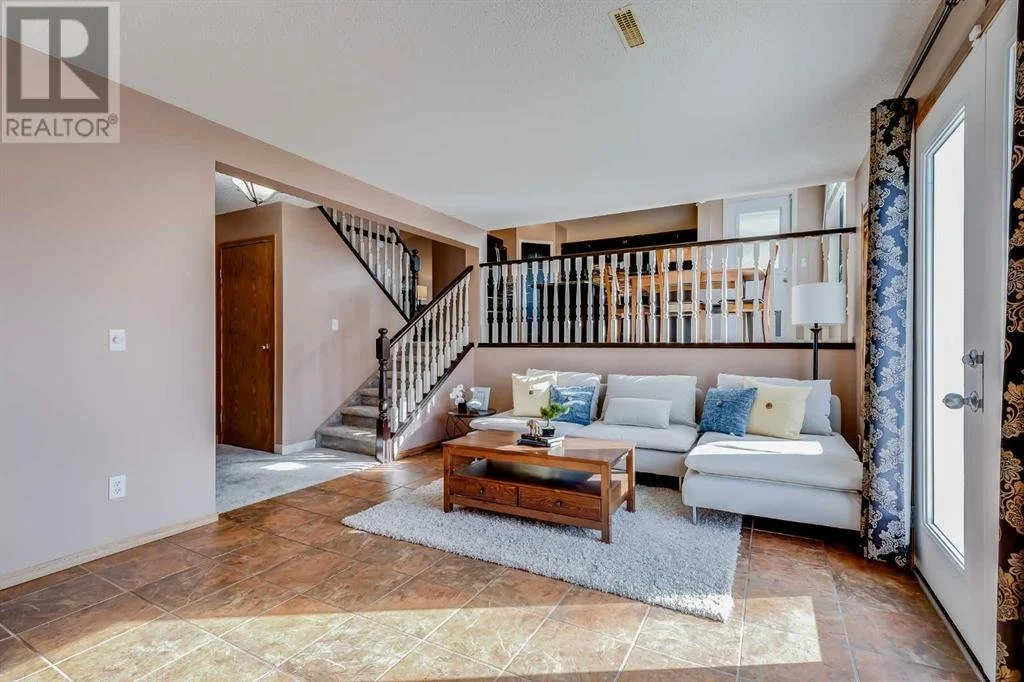
There’s something about a sunken room that feels like a memory. You step down and immediately feel tucked in—like the world softens just a little. Kids playing below while you cook above, voices echoing between floors. People often say the kitchen is the heart of the home, and maybe it is, but the living room… the living room is the heartbeat. It’s where the pulse slows. Where the day exhales.
And in that sunken space—with its gas fireplace and French doors opening to the yard—I saw what it could be. The bones were good, and it deserved to feel as intentional as it looked in my mind.
How the Ceiling Chose Us
Fast forward. We called in our electrician to move an awkward track light that sat directly above the fireplace. Simple enough, right? But when we came downstairs later, there it was—a massive strip cut through the ceiling.
Because our home’s a four-level split, he had to work around trusses and beams. What began as a little light relocation turned into a full-blown ceiling situation.
And we had a photoshoot booked in three weeks.
I’ll never forget the look Carlos and I exchanged. Mine said, “We need a plan.” His said, “You have too many plans.”
That was the moment the coffered ceiling was born.
Why Coffered
I’d done the popcorn-scraping thing before—in our front sitting room—and vowed not anytime soon again. I can still feel the distant kink in my neck. After that tiny room, I knew we’d never finish in time going that route.
But as I stared at the open ceiling, I kept tracing lines with my eyes, imagining how to frame it in. The fireplace millwork already reached up in rhythm; extending it across the ceiling just made sense.
Even in an 8-foot room, sometimes you shouldn’t fight what you have—you should frame it. Depth can be beautiful when it’s intentional, and a coffered design would give the illusion of structure and quiet symmetry.
Building It
We started with math—lots of it. We measured, divided, re-measured, and taped off where each beam would fall.
Then came the big MDF sheets, cut to size for the inside panels of each coffer. Once they were laid out, we attached 2x4s into the studs to create the frame—simple, and nowhere near as time-consuming as popcorn removal. (I’d probably still be scraping one tiny section.)
After that, we boxed everything in with 1x3s on the sides and 1x6s on the underbelly. The size of the side pieces determines how deep your coffers feel. For 8-foot ceilings, I wouldn’t go deeper than 4 inches; balance is everything.
And then came the crown moulding. Oh, crown moulding—the part that can humble anyone. My advice? Take your time. Label each cut. Step back often. And when you get frustrated (because you will), remember: every imperfect corner gets caulked anyway.
What It Gave Back
When the final coat dried, I stood there, neck craned, just staring. The ceiling didn’t make the room feel smaller—it made it feel complete.
It’s funny how often beauty comes from accidents. What started as a cut-open ceiling turned into a defining feature of our home. And now, when the afternoon light hits those beams, the whole room glows with warmth and intention.
Sometimes the best designs aren’t planned. They reveal themselves mid-chaos—dust in your hair, deadline looming—and they whisper, “Trust me, this is where it gets good.”
P.S. If you want the nuts-and-bolts—measurements, spacing, and our exact materials—say the word and I’ll drop a full plan set in a follow-up post.